The Seeds of Creativity
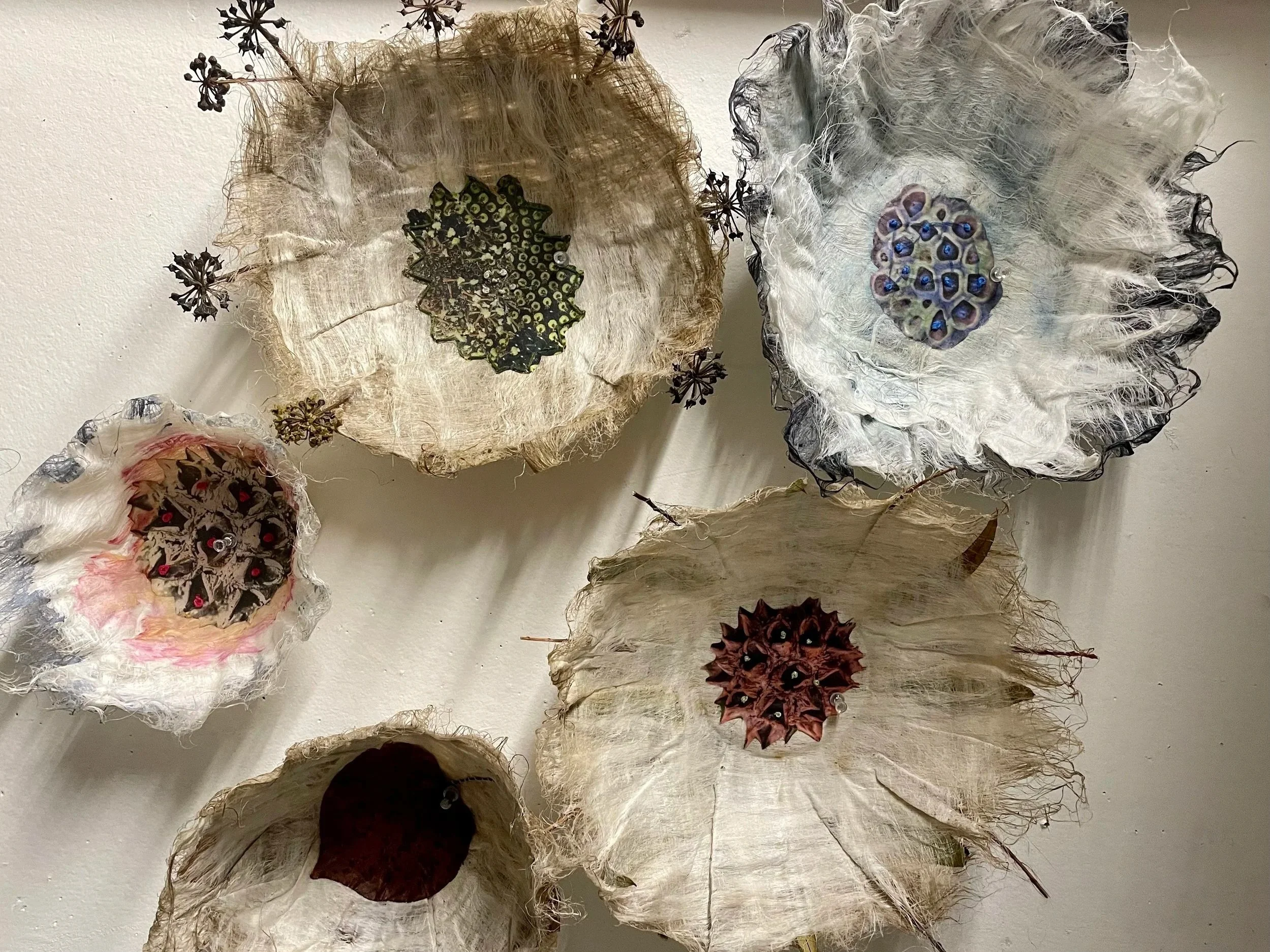
NEW SEEDS SEWN INTO MY FIBRE BOWLS
I think about seeds a lot when I’m in the middle of making something and nothing seems to be happening.
I think about them especially around the winter solstice—the darkest point of the year, when growth appears to pause and the world seems to hold its breath.
A seed is such a quiet thing. It doesn’t announce itself. It doesn’t rush. It doesn’t explain its plan. It just holds possibility—compressed, patient, alive—and waits for the conditions that let it become more of itself.
From the outside, a seed looks like nothing is going on. But that’s only because most of its work happens in the dark.
The winter solstice carries this same wisdom. It reminds us that darkness is not an absence, but a container. A necessary stillness where essential things are quietly reorganizing.
This feels deeply familiar to me as an artist.
In the art process, the most important moments are often invisible. Before there is form, there is listening. Before action, there is absorption. Before growth, there is a period of rest that looks suspiciously like stillness—or even failure—if you don’t trust what’s happening underneath.
Seeds teach us about pace.
At the solstice, the days stop shortening. The light doesn’t suddenly flood back in—but it turns, almost imperceptibly. The shift is subtle, patient, and profound. Growth doesn’t begin with brightness; it begins with a change in direction.
A seed never apologizes for how long it takes. It doesn’t compare itself to the seed next to it. It doesn’t try to bloom early because another plant already has. Each seed carries its own timing, its own internal clock, and it unfolds when it’s ready—not when it’s convenient.
In creative work, we’re constantly tempted to rush the sprout. We want the finished piece, the clarity, the proof. But creativity doesn’t respond well to pressure. Like seeds, ideas need space, moisture, warmth, and time. Too much force can crack them before they know how to grow.
Seeds also teach us about faith.
The solstice asks for this same trust. You can’t yet see the longer days. You feel them only as a promise. And still, something in the body knows the light is returning.
You plant something without guarantees. You don’t dig it up every day to check if it’s working. You trust the intelligence inside something you can’t yet see. You tend the conditions, not the outcome.
This is the heart of the art process for me: showing up, making space, and trusting that something meaningful is forming even when I can’t name it yet. Especially when I can’t name it yet.
There is also a radical creativity in seeds.
No two grow the same way. They respond to their environment with ingenuity—leaning toward light, rooting around obstacles, adapting their shape to what’s available. Creativity isn’t about control; it’s about relationship. Seeds don’t dominate their surroundings. They collaborate with them.
As artists—and as humans—we’re often taught to push, to optimize, to perform. Seeds remind us that creativity is not a performance. It’s a conversation. One that requires attention, humility, and patience.
And maybe most importantly, seeds remind us that beginnings don’t look impressive.
The winter solstice doesn’t arrive with fireworks. It comes quietly. Often unnoticed. But it marks a threshold—a turning point that reshapes everything that follows.
They look small. They look ordinary. They look like nothing much.
But inside each seed is a complete set of instructions for becoming something only it can become.
When I feel stuck, slow, or uncertain in my work, I try to remember this: not all growth is visible, and not all progress is loud. Sometimes the most creative thing we can do is stay planted, stay open, and let our own timing lead.
The seed knows what it’s doing.
So does the dark.
So does this moment of stillness.
And so do you.
So do you.